
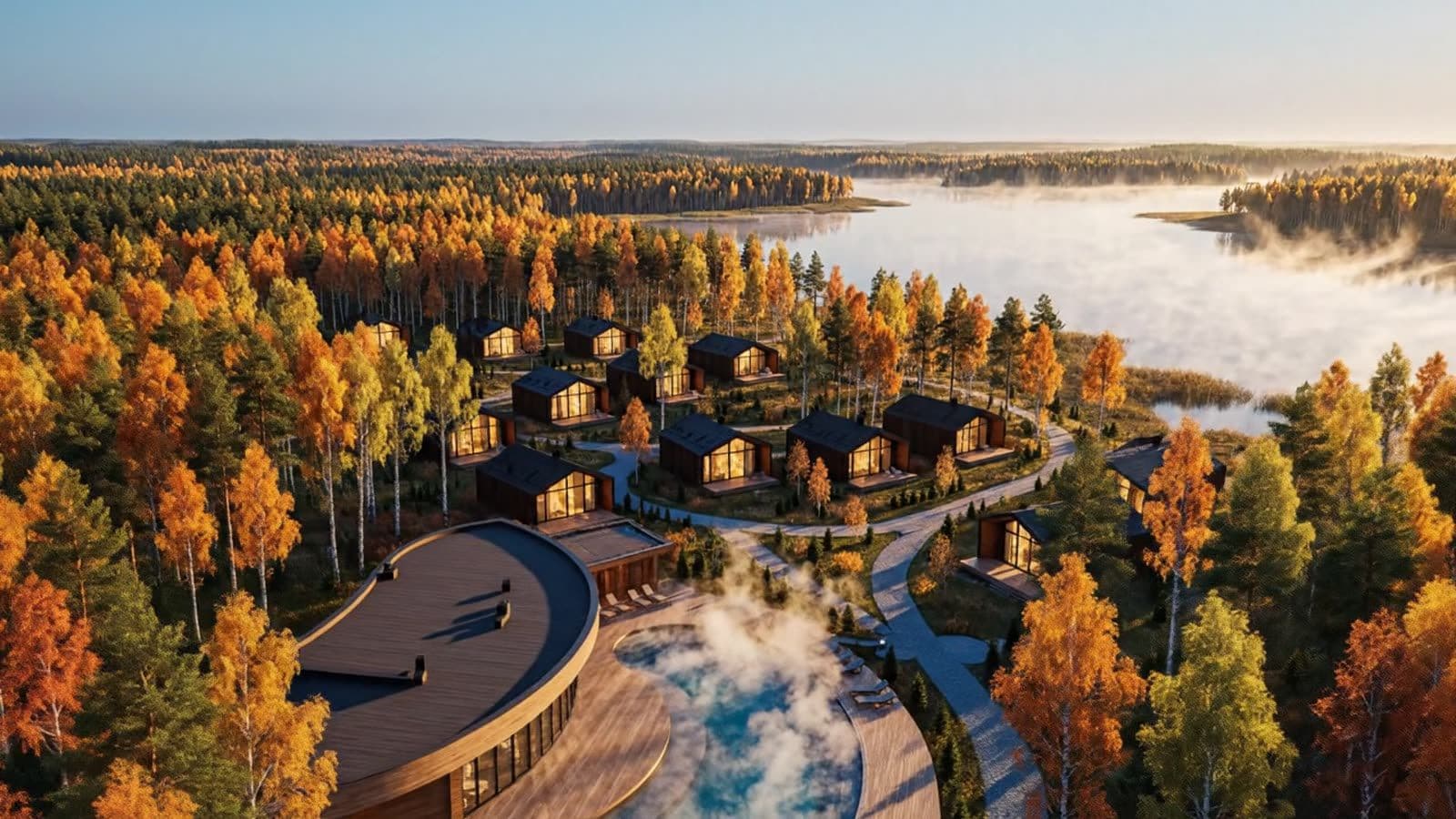
ISTOK — a wellness village 110 km from Moscow
Twenty hectares for a wellness village: a thermal spa, a recovery centre, a restaurant fed by its own farm, houses in a rental pool and private residences. A retreat centre has been trading next door for several years — demand for the format on this spot has been proven by someone else, not by us.
- site area
- 20hasite area
- to Moscow
- 110kmto Moscow
- from the city centre
- 90minfrom the city centre
- of investor income
- 3streamsof investor income
This page sets out the intent of a project still in development. Site parameters, the mix of facilities and the economics will be firmed up once the land’s planning status is verified and the architecture is designed. It is not an offer and not a promise of returns.
Demand has already been proven next door
A retreat centre has operated on the adjoining site for several years: houses, a restaurant, a yoga hall, a bathhouse. This is not our forecast but a trading business next to our land, and it shows that the format survives here all year round.
The neighbouring project’s figures are given for reference, taken from its own deck and from its owner. We have not audited them and we do not carry them over to our own project.
Why a wellness village rather than another housing estate
Wellness stopped being a once-a-year trip
People no longer book a single annual stay at a sanatorium. Demand has moved to short, repeated breaks of two to four days: recover, sleep, switch the phone off. That guest comes six to eight times a year instead of once.
Moscow is close, but you cannot hear it
Ninety minutes from the centre is weekend distance. People travel further only reluctantly, and any closer there is no silence and no forest left. Borovsky district sits exactly in that band.
A house here is an asset, not a second home
The owner is not obliged to turn up: the house works in a managed rental pool. They receive income and a few weeks of their own each year, rather than the burden of an empty plot.
The facilities earn on their own
The thermal spa, the restaurant and the health centre sell to outside visitors as well as to residents. That is a second revenue stream, independent of how fast the land sells.
Land gains value from build-out, not from waiting
A plot appreciates when roads, utilities and a working anchor appear next to it. We are not selling the expectation of growth but specific construction milestones, with prices tied to them.
The format reads clearly to a foreign investor
A wellness resort with a management company and a rental pool is a standard model in the Emirates and across Asia. An investor does not need to decode the quirks of Russian country-house estates.
How the twenty hectares are laid out
Tap a zone to see what it is for. A third of the site is water and woodland and stays unbuilt: that is precisely what people come here for.
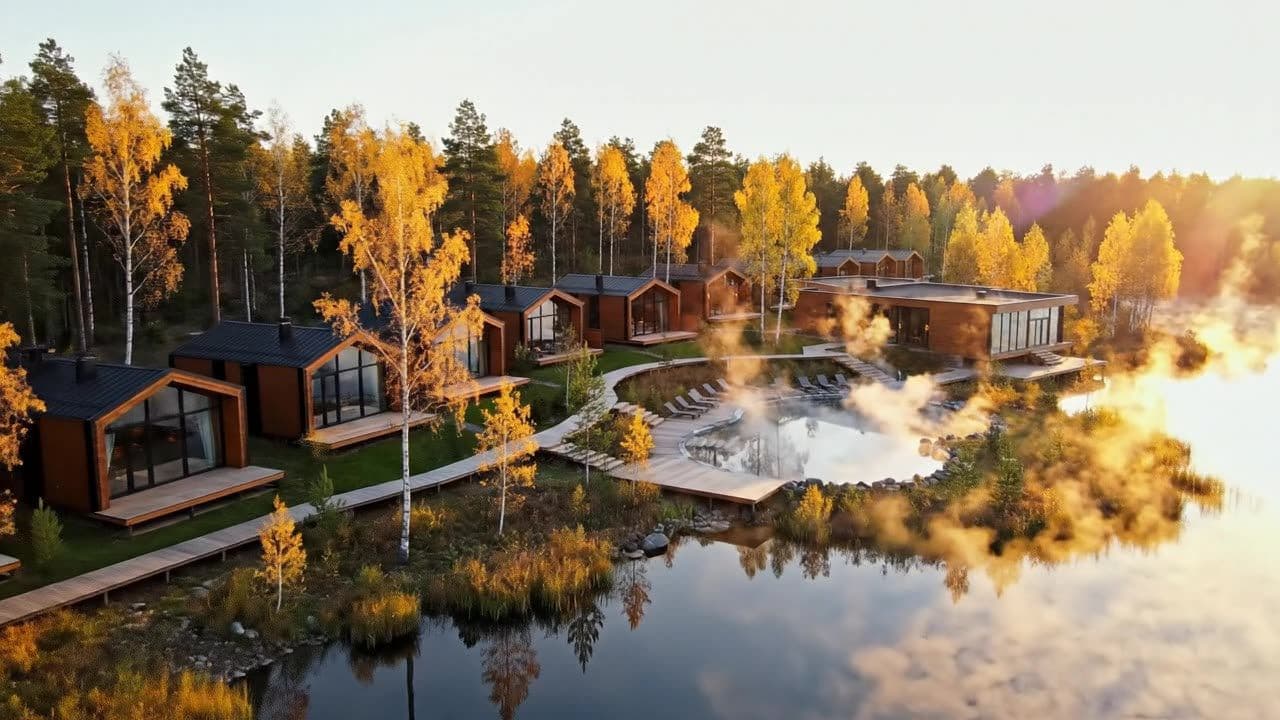
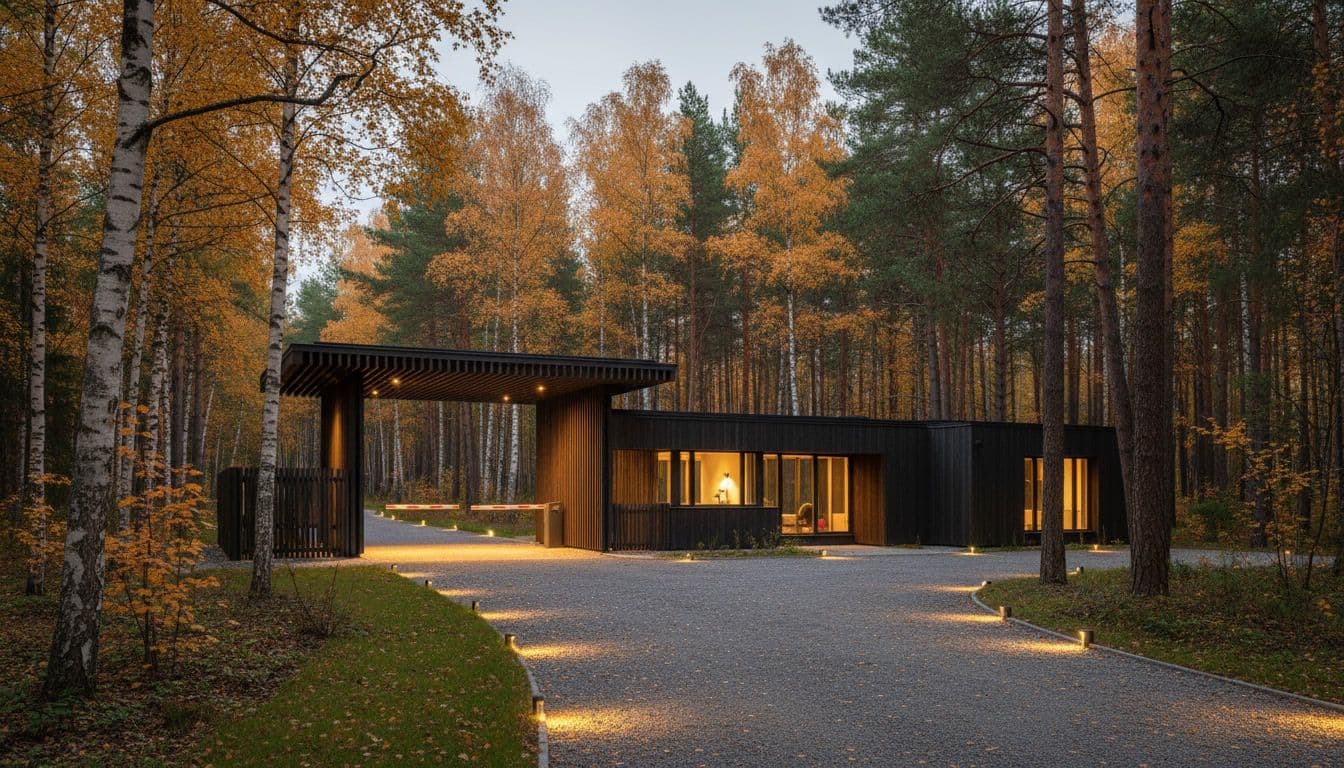 Artist's impression
Gatehouse
Controlled entry, reception and parking for guests and residents. Beyond this point the site is electric vehicles and walking only.
The diagram is indicative: it shows the logic of the site before survey and architectural design. Areas and building positions will change once the project is drawn.
Four types for different investor goals
Studio
One module: a bedroom-living room, bathroom and a terrace with a view. The base unit of the rental pool — the highest occupancy and the fastest payback.
Couple’s house
Two modules: bedroom, living room with kitchen, and a sauna or hot tub on the terrace. The core weekend format.
Family house
Three or four modules: two or three bedrooms, a shared living room, a utility room and entrances on two sides. Suitable for living here full time.
Residence
A bespoke design within the estate’s architectural code, on a plot from 1,500 m², with its own spa wing.
Factory-built modular houses
Houses are assembled in a factory and delivered as finished modules. For an investor this is not a matter of taste but of how fast capital turns over.
A finished shell goes onto prepared foundations in a few days. The first rental income arrives in the same season the money went in.
A factory quote does not drift with the weather or the crew. Budget variance is measured in percentage points, not multiples.
The thirtieth house matches the first. For a rental pool that is critical: the guest is paying for predictability.
The site does not stand idle for half the year. Construction runs year-round instead of chasing the season.
No supplier has been chosen yet. Chinese modular plants offer the best price per square metre but require due diligence: certification to Russian codes, logistics, warranty and service inside Russia. That is a separate selection stage before construction starts.
Three income streams instead of one
An estate that earns only by selling plots lives exactly as long as the last plot. Here land sales are one source of three, and the other two remain once there is nothing left to sell.
Sale of plots and houses
The main return of capital. Land is released in phases, each priced above the last because utilities and facilities are already in place.
Rental pool
The company runs the guest houses and shares revenue with the owners. An investor can enter through houses rather than land and take the cash flow without touching sales.
Facilities
The thermal spa, the restaurant and the health centre sell to outside visitors, not only to residents. This stream is independent of the pace of land sales and grows with the reputation of the place.
On returns, plainly
We will not quote a percentage until it has been calculated on verified numbers. Building the model needs the title register extract for the site, the entry price of the land and the cost estimate for phase one. Once we have them we will show the workings with every assumption exposed — you can argue with those, and you cannot argue with a pretty number on a slide.
Three forms of participation
Equity in the project
Cash into the Russian project company for a shareholding and a right to profit. Suited to a large cheque and a long horizon.
Houses in the rental pool
Buying one or more houses and placing them under management. A legible asset, a legible income, exit by selling the house.
Project finance
A secured loan to the project at a fixed rate. No exposure to operating risk and no rights over the land.
How a foreign national can invest in land and in the project in Russia
The question investors from the Emirates and Asia ask first is whether they can own land here at all. They can, but not everywhere and not in every form. Below are the workable routes, each tied to the law behind it.
Border territories — not permitted
Foreign nationals, stateless persons and foreign legal entities may not hold freehold title to land in border territories. A transaction made around that ban is void.
The Kaluga region has no international border, is not on the list and cannot join it: the list is built outward from the national frontier. The restriction does not apply to our site.
Land Code of the Russian Federation, art. 15(3); the list is set by Presidential Decree No. 26 of 9 January 2011
Agricultural land — lease only
Foreign nationals, foreign companies and Russian companies more than half foreign-owned cannot hold freehold title to agricultural land. Leases run from 3 to 49 years, but the option to buy is closed to a foreign lessee.
The threshold is written as “more than 50%”, so exactly half in foreign hands is permitted. That is a workable lever if agricultural land does end up inside the project.
Federal Law No. 101-FZ of 24 July 2002, art. 3
Converting agricultural land to tourism use is now close to impossible
Since 1 March 2026 any change of permitted use or reclassification of farmland runs through the federal Ministry of Agriculture and a regional statute, and farmland boundaries are entered in the register by separate orders. From 1 January 2027 the list of grounds for reclassification becomes exhaustive, and neither tourism nor recreation appears on it.
This matters more than the investor’s nationality. Buying a field and reclassifying it later has stopped working for everyone, Russians included. The site therefore has to carry the right status from the outset.
Federal Law No. 295-FZ of 31 July 2025; Government Decree No. 1943 of 28 November 2025
Settlement land for tourism — permitted
Outside border territories a foreign national acquires settlement land on ordinary terms. Our format needs the permitted use to be “tourist services” or “recreation”.
This is the target scenario: settlement land with a tourism permitted use removes both the restrictions on foreign ownership and the reclassification problem.
Land Code of the Russian Federation, art. 15; classifier of permitted land uses, codes 5.2.1 and 5.0
Commission approval: when even a non-listed country needs it
A special regime for property transactions applies to persons connected with states on a designated list. The UAE, China, India and the Gulf states are not on it.
There are two traps. First: approval is also required from an investor in a non-listed country if the seller bought the asset after 22 February 2022 from a person in a listed state. Second: if the Dubai company is controlled by a person from a listed state, the rule bites on control rather than on place of registration. Both are checked before the deal.
Presidential Decree No. 81 of 1 March 2022, clause 1(a) and 1(c); the list is set by Government Order No. 430-r of 5 March 2022
What we recommend for a UAE investor
A Russian limited liability company in which the investor is the sole or controlling shareholder, with the land bought onto that company’s balance sheet. Funding through equity plus an intragroup loan, watching the debt-to-equity limit.
- The ban on foreign legal entities is aimed at foreign companies: a Russian company falls outside it even when wholly foreign-owned
- Construction costs and depreciation reduce profit tax, and VAT on construction is recoverable — an individual has neither option
- It creates an entity that can run a hospitality business: glamping and a spa are services, and a private landowner cannot supply them in their own name
- No government commission approval is needed: incorporating a company is not a transaction in shares
- The same company later opens the route to a residence permit on investment grounds
Five entry routes
A Russian company with a foreign shareholder
- Rights over land
- Yes, even at 100% foreign ownership; for agricultural land, foreign ownership must not exceed 50%
- Commission approval
- Not required
- Tax
- Profit taxed at 25% after deductions; dividends at 15%, or 10% under the UAE treaty
- Best suited to
- The main route: investing cash into the project.
- Works with settlement land under full foreign ownership
- Construction costs reduce tax and VAT is recoverable
- There is an entity able to run the hospitality business
- Provides grounds for a residence permit
- The company has to be maintained: accounting, filings, a director
- Selling the shareholding is taxed in Russia if the company’s main asset is property
- With agricultural land the foreign stake has to come down to half
Tax and moving money
Rental income and sale proceeds are taxed at thirty per cent for a non-resident, with no deduction for costs. The progressive scale does not apply to non-residents. An investor becomes a resident by spending more than 183 days a year in the country.
No tax is due on a sale after the minimum holding period, as a rule five years. Since 2019 the exemption applies to non-residents too.
A Russian company pays profit tax at twenty-five per cent, but with full deduction of construction costs and depreciation. For a development project that is fundamentally better than thirty per cent of turnover paid by an individual.
The new double tax treaty was signed in February 2025, entered into force that July and has applied since 1 January 2026. It cuts withholding tax to ten per cent on dividends, interest and royalties, against fifteen and twenty under general rules.
From 1 January 2026 the Emirates were removed from the offshore lists by orders of the Ministry of Finance. That lifts a whole layer of restrictions on capital contributions and on controlled foreign company rules.
The special-account restrictions are aimed at creditors from listed states and do not apply to a UAE investor: dividends are paid in the ordinary way. The bottleneck here is not the law but bank compliance and payment channels, so the settlement structure is agreed with the bank in advance.
To apply the reduced treaty rate you must confirm UAE tax residence and beneficial ownership before payment. Rates and procedure change: get a calculation from a tax adviser before transacting.
Five checks before the deal
These are the points where a project breaks. We work through them with counsel before any money moves.
- 01Land category and permitted use
The register extract, the local zoning rules and the district masterplan. If the site lies outside settlement boundaries and counts as agricultural, the whole entry structure changes. This is the first question, not the fifth.
- 02How the seller acquired the site
If the seller took the land after 22 February 2022 from a person in a listed state, a purchase by a UAE investor needs government commission approval, which takes six months or more. Checked against the record of title transfers.
- 03Control over the investor’s structure
If the ultimate beneficial owner of the Emirates company is a person from a listed state, the special regime applies by control rather than by place of registration. The ownership chain is disclosed before signing.
- 04Zones with special regimes
The national park and its buffer zone, water protection strips, heritage protection zones, airport approach areas, forest fund land. Any overlap with a protected area or forest fund closes private ownership to everyone, not only foreigners.
- 05Farmland boundaries in the register
Since March 2026 the Ministry of Agriculture has been setting farmland boundaries region by region. We need certainty that the site is not inside them and will not be: otherwise the regime tightens and reclassification becomes near impossible.
Residence permit and entry
Plainly: buying land does not bring a residence permit, and Russia has no residency-by-property programme. The realistic route runs through the same project company on investment grounds: at least thirty million roubles invested in a company that has traded for three years by the time of application and paid at least six million in taxes and contributions for the previous year. The permit therefore arrives in the fourth year of a working business, not on the day the land changes hands.
Until then no visa is needed at all: UAE citizens enter Russia visa-free for up to ninety days in any one hundred and eighty. That is enough to oversee construction.
Federal Law No. 115-FZ of 25 July 2002; Government Decree No. 2573 of 31 December 2022
This material is for information only and is neither a legal opinion nor tax advice. The rules are stated as at the date checked; the lists of border territories and listed states, and the rules on agricultural land, all change. Before any transaction we prepare a legal opinion on the specific structure together with specialist counsel. Checked on 23.09.2026.
An in-house management company
We do not hand the estate to an outside operator. ZemFond’s service company runs the site after construction, and the rental pool is managed by the same team that built it.
- Site operations: roads, power, water, waste, snow clearing, security
- Rental pool: guest check-in, cleaning, linen, repairs, owner reporting
- Occupancy: marketing, booking channels, corporate and retreat groups
- Owner services: looking after the house, preparing it for arrival, minor repairs
- Transparency: per-house reporting in your account on this site
Five stages from land to a working asset
Land and planning status
Title register extract, verification of land category and permitted use, change of use where needed, utility connections, topographic survey.
Concept and masterplan
Architectural concept, zoning, building positions, engineering design, and a financial model built on verified numbers.
Phase one
Roads, utilities, the gatehouse, the thermal spa and the first rental-pool houses. From this point the site starts earning.
Sales and fit-out
Releasing plots in phases, opening the restaurant and the health centre, hiring the management team.
Reaching full capacity
Full build-out, stable rental-pool occupancy, and the option to sell the project whole or in part.
What investors ask
What stage is the project at?
The land is identified and the concept is drawn up. Ahead lie verification of the site’s planning status, the architectural masterplan and a financial model built on verified numbers. That is why this section is marked as in development: we are showing intent and reasoning, not a finished offer.
What makes you confident the format works on this spot?
A retreat centre with houses and a restaurant has traded on three hectares next door for several years and stays busy year-round. We are not copying it; we are adding what three hectares cannot hold — a thermal spa, a medical offer and a rental pool of real scale.
Can a foreign national own this land?
Yes, if the site is settlement land: Borovsky district is not a border territory and the ban on foreign ownership does not apply here. But we recommend a different route — buying through the investor’s own Russian company, which is better on tax and allows the hospitality business to trade. All the routes are set out in the section for foreign investors below.
What is the return?
The honest answer: not yet a number you could rely on. The neighbouring project reports around ten per cent a year, but that is its figure, not our forecast. We will build our own model once the land status and the phase-one estimate are verified, and show it with every assumption on the table.
Who operates the asset after construction?
ZemFond’s service company. It already maintains our estates: roads, utilities, owner services. For the rental pool a hospitality arm is added — check-in, housekeeping, occupancy, reporting.
Can we come and see it?
Yes. The operating centre next door is open, you can stay there and see the format from the inside. Our site is adjacent and we show it on the same trip.
Request the project materials
We will send the concept, the site diagram and the land parameters, and the financial model once the land status is verified. We will arrange the trip: you can stay in the operating centre next door and see our site on the same visit.
Cadastral number of the site: 40:03:081202:14